cryptoby Neel K
Crypto Perpetuals Arbitrage: Profiting From Price Imbalances Across Exchanges
5 min read7 January 2026857 reads
Written by

4 followers
Crypto perpetual futures (perps) are one of the most liquid and actively traded instruments in the market. But liquidity does not always mean efficiency.
At times, the same perp contract for a token can trade at meaningfully different prices across exchanges creating opportunities for perpetual arbitrage.
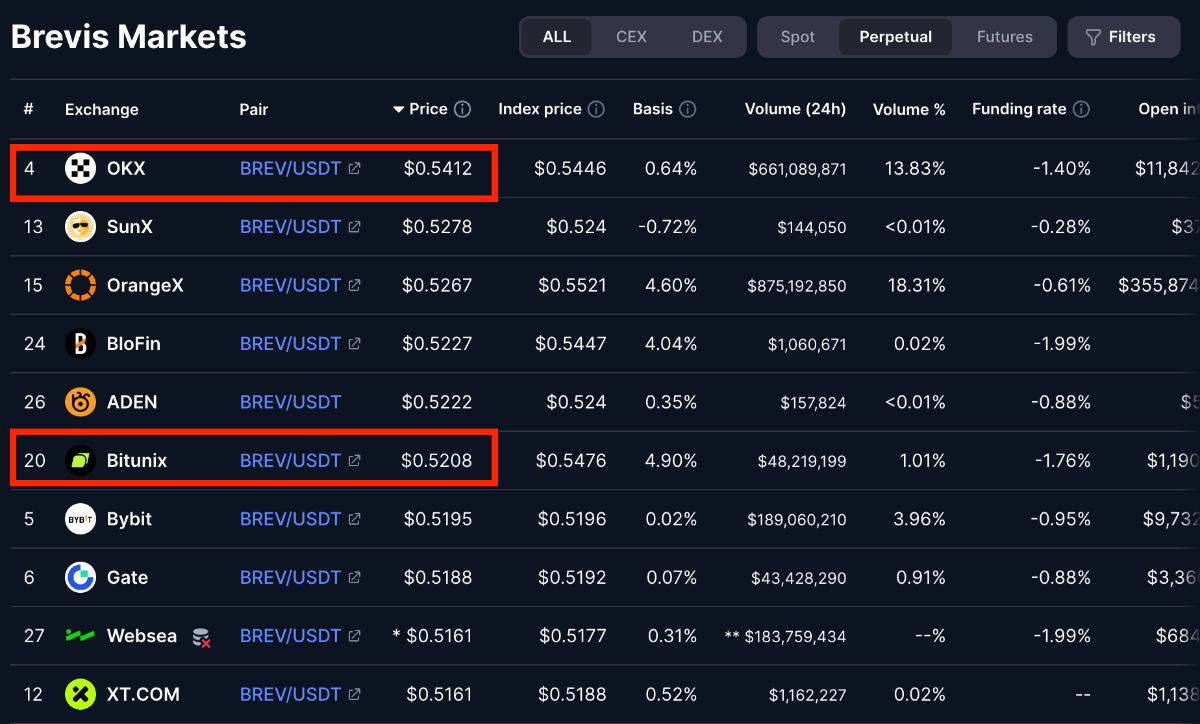
If done correctly, this strategy allows traders to profit with direction-neutral exposure, where the main cost is funding fees, not price prediction.
What Is Crypto Perps Arbitrage?
Perpetual arbitrage is a market-neutral strategy where you:
Long the perp where it’s cheap
Short the perp where it’s expensive
Hold until prices converge toward a common equilibrium
Because you are both long and short the same asset, overall market direction matters less.
The objective is to profit when prices converge toward a common equilibrium, rather than betting on whether the asset goes up or down.
Because exposure is hedged, overall market direction matters less than how prices normalize across venues.
Example
Lets look at prices of RIVER/USDT on coinmarketcap across exchanges:
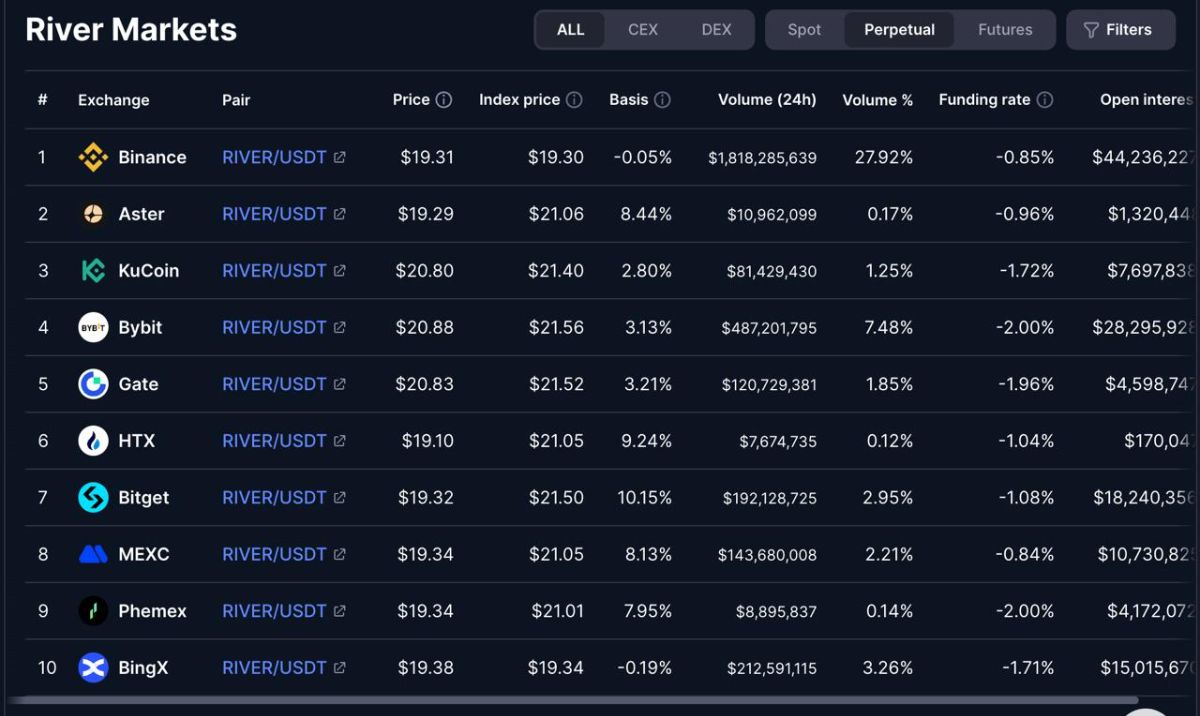
In the RIVER/USDT perp market, we observe:
One major exchange trading near $19.3, tightly aligned with its index
Multiple other exchanges trading near $20.8–$21.0
Negative funding across nearly all venues (shorts paying longs)
The price on Bitget is approximately 11.40% higher than on Binance.
At first glance, this looks like a straightforward arbitrage. But the real question is:
Where does convergence happen?
Three Valid Convergence Outcomes
1- Everyone Moves Down
If spot liquidity weakens or inflated index feeds correct:
Higher-priced exchanges fall toward ~$19.3
Index prices adjust downward
Arbitrage resolves through downward convergence
This is the outcome many traders assume but it is only one possibility.
2- The “Cheap” Exchange Moves Up
If spot buying emerges or index feeds normalize upward:
The lower-priced venue rises
Other exchanges barely move
Final equilibrium forms above current prices
Traders who assumed “overpriced must fall” get trapped.
3- The Index Moves and Prices Meet Elsewhere
The most realistic scenario.
Binance (or another dominant venue) moves up
Other exchanges move down
The index recalculates in real time
Final price stabilizes at a new level unrelated to today’s midpoint
Convergence is path-dependent, not symmetric.
What Actually Forces Convergence?
Not price symmetry — economic pressure.
1- Funding rates
Negative funding means:
Shorts are paying
Longs are incentivized
Over time, price pressure is upward, not downward
2- Liquidity dominance
The exchange with:
Highest volume
Deepest spot liquidity
typically dictates the final equilibrium price.
3- Index mechanics
Indexes are formulas not truth.
They can lag, overshoot, and correct abruptly.
The Real Risk: Funding Fees
Perpetual arbitrage is not “free money.”
The main cost is funding, and it compounds fast.
Key complications:
Different exchanges use different funding intervals
Some reduce funding windows to 1 hour on volatile assets
Others adjust rates aggressively to discourage arbitrage
A position that looks profitable on price alone can be net negative after funding.
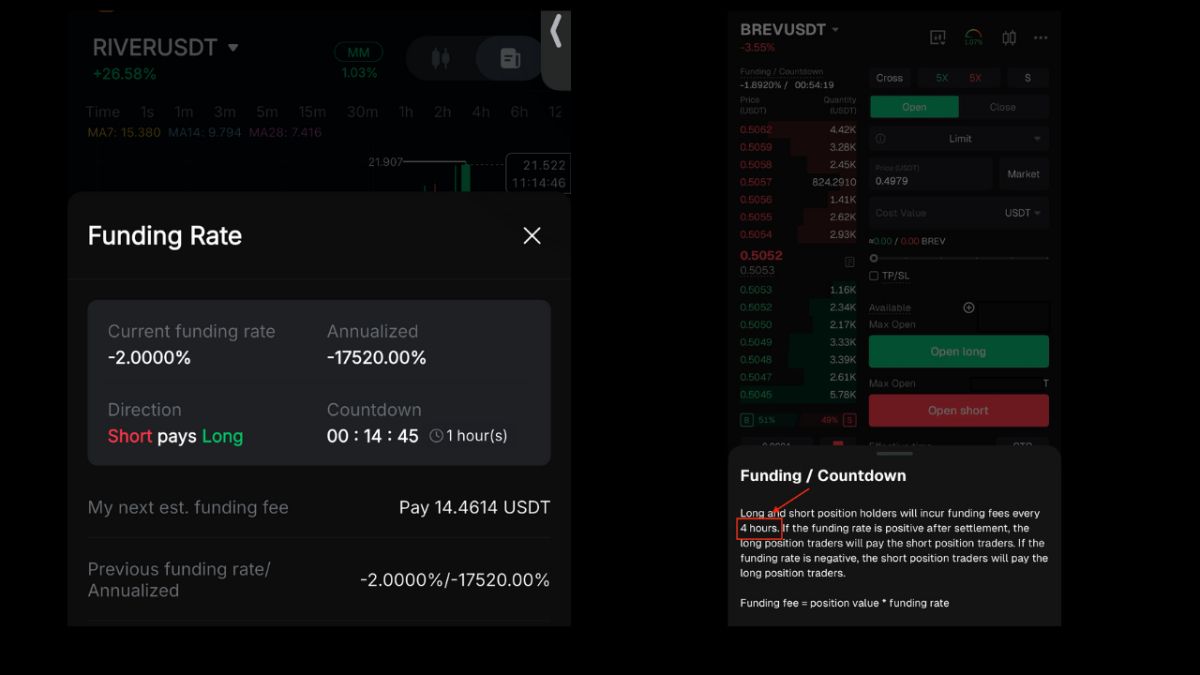
Here you can see bybit (left) charging funding ever 1h and Biunix (right) charging it every 4h
Timing and Funding Strategy
Skilled arbitrageurs don’t just look at price — they track:
Funding countdown timers
Which side pays funding
How often it resets
Common approaches:
Enter after funding is paid
Exit before the next funding
Or intentionally farm funding while hedged
Funding management often matters more than price convergence itself.
Hidden Risks Most Traders Ignore
Even market-neutral strategies carry risk:
Liquidity risk when exiting both legs
Index manipulation on thin spot markets
Auto-deleveraging (ADL) on smaller venues
Exchange risk (halted withdrawals, margin changes)
Unequal margin rules across exchanges
Perp arbitrage reduces risk — it does not eliminate it.
The Correct Mental Model
You are not trading price direction.
You are trading relative mispricing under funding pressure.
Convergence is:
Dynamic
Influenced by liquidity
Driven by incentives
Not a clean midpoint, and not guaranteed on your timeline.
How to Trade these opportunities?
STEP 1: Find a Tradeable Dislocation
Do not start with the biggest price gap.
Start with the cleanest one.
Minimum checklist:
Same contract (USDT perp vs USDT perp)
Spread ≥ 3–5%
Both venues have:
Real volume
Non-zero open interest
No upcoming:
Contract expiry changes
Index feed updates
Maintenance windows
Red flag: Huge spread + tiny volume = trap.
STEP 2: Decide Which Exchange You Trust More
This is the most important decision.
Ask:
Where is spot liquidity deepest?
Which exchange dominates price discovery?
Which index is derived from better spot sources?
Practical rule:
Trust the exchange with the deepest spot + perp volume, even if its price looks “wrong”.
That venue usually becomes the anchor. I track prices on Binance trade accordingly.
STEP 3: Map the Funding Landscape (Do This Before Entering)
You must know:
Funding rate
Funding interval (1h / 4h / 8h)
Funding countdown timer
You want one of these setups:
Paid on both legs
Paid on one, neutral on the other
Very small cost vs spread
🚫 Avoid entering if:
You’ll pay funding on both legs
One exchange has 1h funding and extreme rates
Close to funding timer
STEP 4: Entry Timing (This Is Where Pros Win)
Best entry moments:
Right after funding is paid
During low volatility
When spread is stable (not expanding)
Avoid:
Entering right before funding
News-driven moves
Index recalculation windows
STEP 5: Position Construction (How to Size Correctly)
You are not hedged unless size is matched.
Rules:
Match USD notional, not contracts
Use low leverage (2–3x max)
Keep margin buffers unequal if one exchange is riskier
Example:
Long $10,000 on Exchange A
Short $10,000 on Exchange B
Never size based on “confidence”.
STEP 6: Monitoring While in the Trade
You should track three things only:
Spread compression
Funding drift
Index movement
Ignore:
Candles
RSI
Narratives
If funding flips against you, reassess immediately.
STEP 7: Exit Logic (Pre-Decide This)
You should enter with one of these exits predefined:
Exit if:
Spread compresses to target (e.g., 1%)
Funding economics turn negative
Liquidity dries up
Index moves against your thesis
🚫 Do NOT wait for “perfect convergence”.
Partial convergence is enough.
STEP 8: Advanced Tactics (Optional)
Funding avoidance
Close just before funding
Reopen after funding
Works best on predictable 8h cycles
Funding farming
Hold only the leg that receives funding
Hedge delta dynamically
Higher risk, higher attention
Common Beginner Mistakes (Avoid These)
❌ Assuming midpoint convergence
❌ Ignoring funding timers
❌ Overleveraging “because it’s hedged”
❌ Trusting thin exchanges
❌ Holding through multiple funding cycles blindly
Perpetual arbitrage works because crypto markets are fragmented, emotional, and structurally inefficient.
The edge comes from:
Understanding who controls price discovery
Respecting funding mechanics
Managing time, not just price
In perp markets, the question is never:
“Is this price too high or too low?”