 Translate
'%3e%3cpath%20fill='%23ffffff'%20d='M%2087.636719%20131.8125%20L%2087.632812%20131.796875%20M%20344.1875%20153.058594%20L%20344.238281%20153.042969%20L%20344.144531%20153.042969%20L%20273.226562%20126.554688%20L%20273.1875%20126.507812%20L%20273.128906%20126.519531%20L%20224.152344%20108.226562%20L%20224.132812%20108.21875%20L%20224.113281%20108.175781%20L%20224.046875%20108.1875%20L%20187.472656%2094.527344%20L%20187.488281%2094.5%20L%20128.769531%20116.429688%20L%2087.625%20131.800781%20L%2030.746094%20153.042969%20L%20104.796875%20180.699219%20L%20107.859375%20181.84375%20L%20150.726562%20197.855469%20L%20187.488281%20211.585938%20L%20229.398438%20195.933594%20L%20267.121094%20181.84375%20L%20276.933594%20178.179688%20L%20344.167969%20153.066406%20L%20344.214844%20153.066406%20L%20344.1875%20153.058594%20'%20fill-opacity='1'%20fill-rule='nonzero'/%3e%3c/g%3e%3cpath%20fill='%23ffffff'%20d='M%20107.859375%20188.507812%20L%20107.859375%20219.835938%20L%20107.863281%20219.835938%20C%20107.863281%20219.859375%20107.859375%20219.882812%20107.859375%20219.910156%20C%20107.859375%20232.941406%20116.6875%20244.746094%20130.972656%20253.316406%20C%20145.398438%20261.976562%20165.390625%20267.34375%20187.488281%20267.34375%20C%20190.335938%20267.34375%20193.144531%20267.25%20195.914062%20267.078125%20L%20195.914062%20267.074219%20C%20217.316406%20265.738281%20236.1875%20259.347656%20249.117188%20249.945312%20C%20260.367188%20241.765625%20267.121094%20231.308594%20267.121094%20219.910156%20C%20267.121094%20219.882812%20267.117188%20219.859375%20267.117188%20219.835938%20L%20267.121094%20219.835938%20L%20267.121094%20188.507812%20L%20187.488281%20218.25%20L%20107.859375%20188.507812%20'%20fill-opacity='1'%20fill-rule='nonzero'/%3e%3cg%20clip-path='url(%236691404858)'%3e%3cpath%20fill='%23ffffff'%20d='M%2092.464844%20259.238281%20L%2092.421875%20258.8125%20L%2089.839844%20231.960938%20L%2089.726562%20230.78125%20L%2088.480469%20217.851562%20L%2089.527344%20217.851562%20L%2089.527344%20203.476562%20C%2090.964844%20202.183594%2091.875%20200.3125%2091.875%20198.222656%20C%2091.875%20197.152344%2091.636719%20196.140625%2091.210938%20195.234375%20C%2090.515625%20193.757812%2089.328125%20192.558594%2087.859375%20191.851562%20L%2087.859375%20174.375%20L%2081.617188%20172.046875%20L%2081.617188%20191.910156%20C%2079.3125%20193.078125%2077.726562%20195.460938%2077.726562%20198.222656%20C%2077.726562%20200.3125%2078.636719%20202.183594%2080.078125%20203.476562%20L%2080.078125%20217.851562%20L%2081.21875%20217.851562%20L%2080.464844%20225.59375%20L%2079.523438%20235.222656%20L%2077.203125%20258.945312%20L%2077.195312%20259.027344%20L%2075.9375%20271.894531%20L%2074.8125%20283.398438%20C%2074.785156%20283.648438%2074.78125%20283.929688%2074.8125%20284.183594%20C%2075.191406%20287.339844%2079.96875%20289.722656%2085.484375%20289.503906%20C%2091%20289.292969%2095.167969%20286.558594%2094.789062%20283.398438%20L%2092.464844%20259.238281%20'%20fill-opacity='1'%20fill-rule='nonzero'/%3e%3c/g%3e%3c/svg%3e)
How Liquidity Pools Actually Work — A Deep Dive into DeFi’s Core Mechanism

1 follower
What Is a Liquidity Pool?
At its core, a liquidity pool is a smart contract that holds a reserve of tokens. These are not just tokens sitting in a wallet — they are locked into a contract that allows anyone to trade, borrow, or provide liquidity in a decentralized way.
Instead of relying on traditional buy/sell order books like centralized exchanges, decentralized exchanges — such as Uniswap, Sushiswap, and PancakeSwap — use liquidity pools to handle trades automatically.
The Role of Automated Market Makers (AMMs)
Liquidity pools power automated market makers (AMMs). These are algorithms/smart contracts that:
Determine the price of assets based on the ratio of tokens in the pool
Allow trades without a counterparty
Enable continuous, permissionless trading
Adjust prices automatically as tokens are bought and sold
The most common pricing method is the constant product formula, often written as:
x * y = k
Here:
x and y are the quantities of two tokens in the pool
k is a constant that stays the same after each trade
In simple terms, when someone buys one token from the pool, its quantity (x or y) decreases, and the price moves up accordingly — maintaining the balance of the equation.
How Trades Happen
In a traditional exchange, trades require buyers and sellers to match. But with liquidity pools:
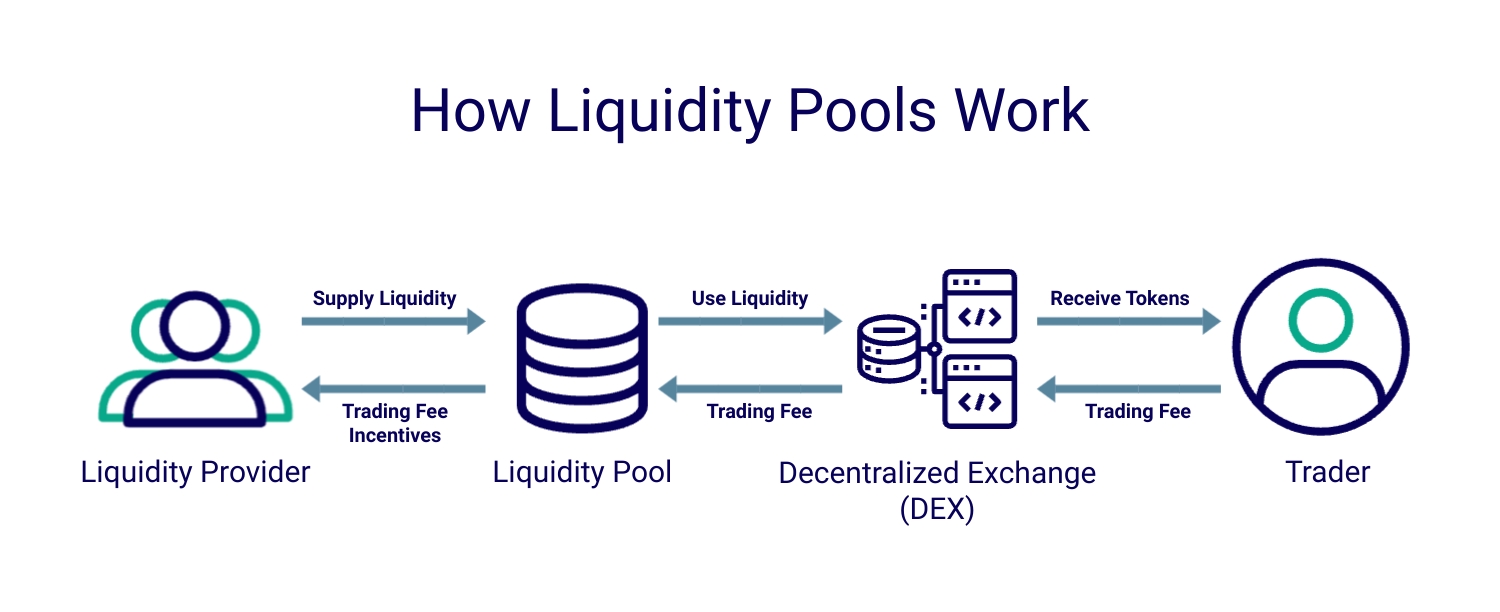
A trader swaps Token A for Token B directly with the pool
The AMM formula dynamically adjusts the price based on supply and demand
Fees are automatically calculated and added back to the pool to reward liquidity providers
This system ensures liquidity is always available, even for less popular assets.
Who Are Liquidity Providers (LPs)?
Anyone can become a liquidity provider by depositing an equal value of two tokens into a pool — for example, ETH and USDC.
In return:
You receive LP tokens representing your share of the pool
These LP tokens act as a proof of ownership
They entitle you to a share of fees generated from trades in that pool
LP tokens can sometimes be staked elsewhere to earn additional rewards — a strategy known as yield farming.
Impermanent Loss
One of the most advanced and crucial risks in liquidity pools is impermanent loss:
If the price ratio of the tokens in the pool changes significantly compared to when you deposited them, you may end up with less total value than if you had just held the tokens.
The loss is called “impermanent” because if prices return to their original ratio, the loss can diminish — but this isn’t guaranteed.
Understanding how impermanent loss works is essential before providing liquidity at scale.
Key Benefits of Liquidity Pools
Liquidity pools are foundational to DeFi because they:
Democratize market making — anyone can participate
Enable decentralized trading without intermediaries
Provide continuous liquidity even in volatile markets
Reward participants with fees and yield farming incentives
Final Thoughts
Liquidity pools are more than a technical feature — they represent a new economic paradigm in finance where liquidity comes from the community, not centralized institutions, and pricing is handled automatically by code.
As DeFi grows, understanding liquidity pools will be essential for traders, builders, and investors alike.
